WaveGate: A case study by New Nostalgia
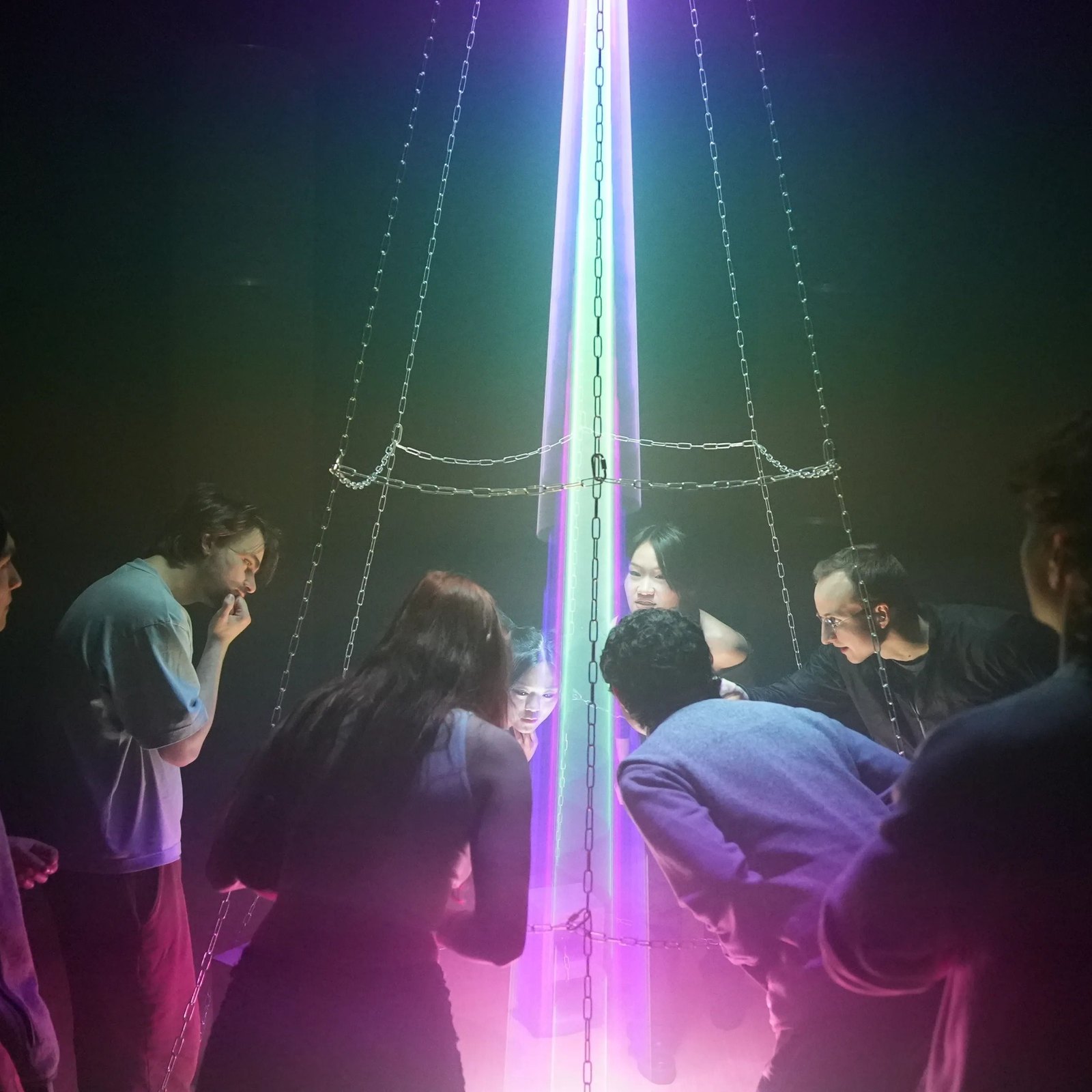
WaveGate was a large, interactive laser installation premiered in San Francisco’s Chinatown in December 2025. Displayed in the center of Moongate Lounge, WaveGate featured a 20 watt laser beam reflected at 45 degrees off a chrome-framed round mirror, shooting up towards the cosmos. Attendees modulated the shape, color, and size of the reflected beam through hand gestures above a custom black podium.
WaveGate, Laser, Mirror, Infrared Sensor
WaveGate Ice Blue Installation View
WaveGate Setup View, San Francisco, CA, 2025
A searchlight towards the stars, illuminating what comes next.
Introduction
WaveGate is both an instrument and invitation. Observers guide the beam, each adjustment uncovering new horizons. When we attune to the energy around us, the next step reveals itself. Synchronizing ourselves with the universe brings clarity to the path ahead. Through laser light, we can visualize the coherent energy that surrounds us and focus the power that defines our way forward.
WaveGate directly connects us to something larger, positioning us within the field of the cosmos. After all, we aren’t just in the universe; we are of it.
New Nostalgia, January 2026
1. Abstraction into Form
Abstraction exists in the realm of ideas—concepts and frequencies that lack physical presence. Form is tangible, occupying space and time. Converting one into the other is an act of translation: making the invisible visible, giving shape to what exists only as possibility or energy.
In early creative reviews for WaveGate, the intention was to signify the future. The forward outlook of the organization—to turn that abstract feeling into a form.
Light offers a natural foundation. It occupies a unique position: both wave and particle, both abstract energy and measurable phenomenon. As James Turrell has often articulated, light is not simply a means of revealing form, but can itself become the form.1
2. Our Quantum Nature
With this foundation in place, the question shifted from form to orientation: how does one relate to the future when it cannot yet be known?
This way of finding orientation through light has a much longer lineage in humanity’s relationship with nature.
In response to industrial rationalism, the American transcendentalist movement argued that truth is not learned through reason, but experienced directly through nature. When direction is unclear, nature has historically served as our tuning mechanism.
As Ralph Waldo Emerson wrote, “The stars awaken a certain reverence, because though always present, they are inaccessible; but all natural objects make a kindred impression, when the mind is open to their influence.”2
For Emerson, the value of nature lies not in clarity or instruction, but in orientation. When direction is uncertain, nature offers calibration rather than answers—an opportunity to attune oneself to rhythms that exceed individual intention. In this sense, gazing skyward at the stars has long been a way of sensing what comes next: not by visualizing a fixed future, but by aligning with the deeper forces that quietly shape it.
This idea finds a parallel in Eastern spiritual traditions, and in the work of artists such as Alex Grey, where individuals will dissolve into alignment with larger cosmic systems.3
Across these traditions, moments of uncertainty become moments of orientation—not toward a predetermined outcome, but toward the underlying structures that guide emergence itself.
3. Future’s Gate
WaveGate was conceived as a bright, reflective laser structure, projecting a concentrated beam that struck a mirrored surface and redirected upward—into the rafters, toward the night sky beyond.
We imagined what it might mean to offer attendees a direct connection to nature, to the cosmos and WaveGate emerged.
WaveGate was designed to be interactive, giving attendees direct control over its energy. Using an Ultra Leap hand gesture sensor, participants waved their hands through a series of constellations and star systems, introducing individual expression into a shared visual spectacle.
Each interaction subtly altered the installation, allowing personal intention to register within a collective trajectory toward the future. Paired with music on the dancefloor, people began to use their hands and dance moves to turn WaveGate into a lightshow. The direct extension of the observer’s hand connected their internal flow state to an external manifestation.
4. Launch
WaveGate was placed at the center of the dance floor within Moongate Lounge. The installation felt harmonious with its surroundings, as a shared circular motif echoed across the glass mirror, the traditional Chinese-style moon gates, and the oculus-like skylight overhead.
During the party, attendees interacting with the piece slipped into a playful mode of engagement. Some explored the finer mechanics of controlling the beam, while others waved their hands rapidly across the camera, testing its responsiveness through motion alone.
Regardless of approach, a consistent sense of fascination accompanied each interaction. Engineers speculated about what was housed inside the podium, while others fixed their gaze on the volumetric beam as it continuously reshaped itself in the air.
Eventually, the gathering gave way to dancing, with WaveGate at the center—its beam cutting cleanly above the crowd.
In that moment, the installation ceased to be a device or a spectacle and instead became a point of shared orientation—an experience that translated abstraction into presence, and collective attention into form.
5. Conclusion
WaveGate invited participants to sense their place within something larger.
In doing so, it illustrated art’s capacity to make an otherwise distant truth present: not by explaining the sky, but by briefly bringing it within reach.1
Technical Overview
This outlines the technical components and interaction system behind WaveGate. It is intended to provide enough detail for others to recreate the installation at similar scales and levels of complexity.
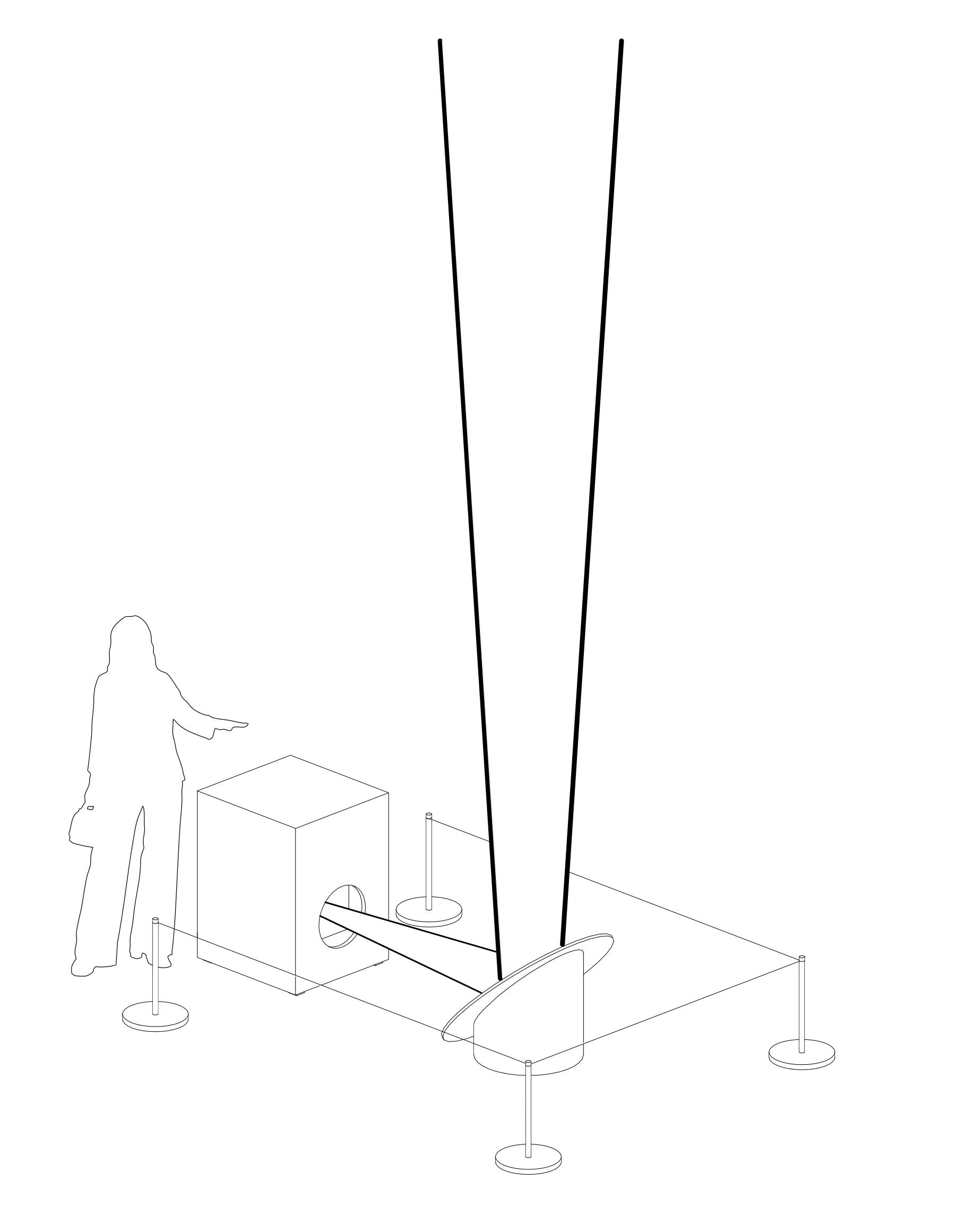
WaveGate uses an infrared hand-tracking sensor to drive real-time laser geometries generated in TouchDesigner and rendered through Pangolin. A fixed mirror redirects the beam vertically, while atmospheric haze reveals the volumetric forms produced through participant interaction.
1. Hardware & Software
Hardware
1× High-power laser projector
1× Leap Motion Ultraleap 2 infrared hand-tracking sensor
1× Fixed mirror (mounted at 45°)
1× Hazer
Software
TouchDesigner
Pangolin Beyond
2. Interaction System
The Leap Motion sensor is mounted facing upward on a podium in front of the laser output zone. TouchDesigner interprets hand gestures and applies pattern-specific mappings to manipulate the laser output.
1. Lateral and vertical hand movement manipulates scale, rotation, and spatial position.
2. Color is modulated continuously during interaction.
3. A pinch gesture cycles through a looping set of predefined geometric patterns.
4. Once a pattern is selected, hand motion sculpts that form in real time.
5. Motion smoothing is applied to create gradual, instrument-like response curves.
6. When no hand is detected, the system enters an idle state.
The pattern set includes simple geometric primitives such as lines, circles, dot grids, triangles, and cubic volumes. When rendered through haze, two-dimensional forms become volumetric structures.
3. Optical Layout
The laser projector is mounted horizontally inside the podium. A fixed mirror positioned at a 45-degree angle reflects the beam vertically.
The podium houses the full system, including the laser, a small fan beneath the projector for airflow, a primary computer running TouchDesigner and Pangolin, and the Leap Motion sensor mounted on the top surface.
A secondary control computer is positioned externally and connected via Anydesk Remote Desktop over WiFi or Ethernet. This allows live adjustments to TouchDesigner during operation, eliminates long USB cable runs to the podium, and enables rapid variation without interrupting participants.
WaveGate installation view, San Francisco, CA, 2025
Citations
- 1 Govan, Michael and Christine Y. Kim, editors. James Turrell: A Retrospective. Los Angeles County Museum of Art / DelMonico Books, 2024, p. 14
- 2 Emerson, Ralph Waldo. Nature. Facsimile ed., edited by Kenneth Walter Cameron, Scholars’ Facsimiles & Reprints, 1940.
- 3 Grey, Alex. The Mission of Art. Shambhala Publications, 2001.
Published by
- Group:
- New Nostalgia
- Editors:
- Aakash Malhotra, Brendan Luu
- Writers:
- Aakash Malhotra, Jordan Ponciano
- Graphic design:
- Brendan Luu
- Printing:
- New Nostalgia, or you
© 2026 by New Nostalgia
Created in San Francisco, CA, USA
All rights reserved
First edition, January 2026