HoloDome: A case study by New Nostalgia
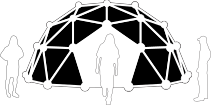
HoloDome was a series of installations created by New Nostalgia that featured dense fog and strobing light, enclosed within a dome structure. Upon entering HoloDome, attendees would see vivid, geometric—often psychedelic—visual patterns.
HoloDome1, LED Array, LED Strobe, Fog, Essential Oil, Shiftpod, Seating
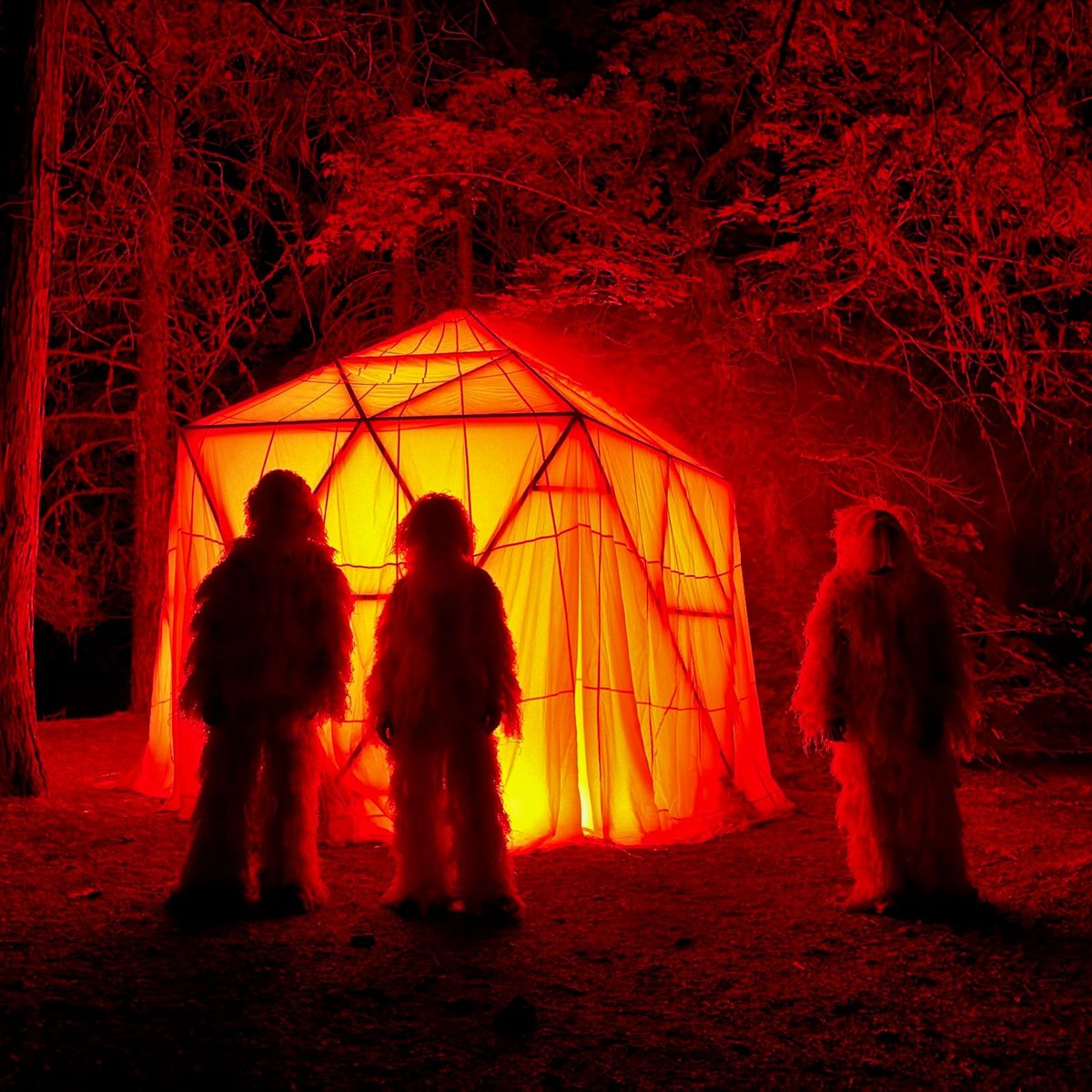
HoloDome2, LED Strobe Array, Fog, Parachute, Existing Structure
People entering HoloDome1, liaised by New Nostalgia members
Photo Colby Xavier Riley
Scenes around HoloDome1
Photo Colby Xavier Riley
HoloDome1, installation view at The Secret Alley, San Francisco, CA, March 2025
Photo Colby Xavier Riley
HoloDome1, installation view at The Secret Alley, San Francisco, CA, March 2025
Photo Colby Xavier Riley
Participants’ drawings from HoloDome’s “Draw What You Saw” exercise
Flyer for HoloDome2
Photo Graphic Brendan Luu
Door coordinators opening HoloDome2 to the public
Photo Aakash Malhotra
HoloDome2, installation view at Patricia’s Green, Hayes Valley, San Francisco, CA, April 2025
Photo Colby Xavier Riley
People gathered outside HoloDome2
Photo Colby Xavier Riley
Street view at HoloDome2
Photo Julian Pelzner
Participant exiting HoloDome2
Photo Colby Xavier Riley
Production team striking HoloDome2
Photo Colby Xavier Riley
Production crew bringing a generator and equipment to the installation site
Photo Colby Xavier Riley
HoloDome1 was a private, invite-only, guided experience showcasing a diverse five-minute program of patterns and strobe rates. The structure itself was a Shiftpod pop-up tent placed in a white wall gallery. Groups of 4–5 people entered HoloDome at scheduled times. After the experience, attendees were encouraged to draw the visual patterns they saw during their journey.
HoloDome2 was a public pop-up, built upon an existing dome structure in Patricia’s Green in Hayes Valley, San Francisco. Lights and fog were placed inside the dome, with a large parachute draped over the structure. Over 120 passersby and attendees lined up to experience a burst of strobe effects lasting 15–20 seconds. We created an arts organization called San Francisco Arts Program (SFAP) to legitimize the installation. We further cosplayed as a construction crew, complete with supervisors and art liaisons.
Introduction
In a world where media constantly pulls our attention in multiple directions, our lives begin to feel compartmentalized and fragmented. This disconnection contributes to a growing sense that the world is becoming increasingly weird and confusing. In contrast, humans experience a sense of wholeness during moments of connection to essence—the underlying energy beneath consciousness. In times like these, it’s crucial to remember that essence exists.
HoloDome was a sensory experience designed to reset our perception. Utilizing dense fog and strobe lights, it created a focused environment that heightened our awareness of reality. Waves of light enveloped participants as their bodies and minds synchronized with the strobe frequencies. This collective synchronization served as a reminder that we are connected—through something deeper, something beyond ordinary perception.
New Nostalgia, April 2025
We live in a thousand stories at once, yet none feel fully our own.
1. The Ganzfeld Effect
A few days after our previous installation, AiBeacon, our friend Gray Crawford claimed he saw fleeting geometric patterns during intense moments of laser strobing. Curious about what he “saw,” we decided to dig deeper into the effects of strobing lights on visual perception. We quickly discovered a long list of strobe lighting-focused installations—namely James Turrell’s Perceptual Cells series.
Reading about it introduced us to the Ganzfeld effect, a German term describing a uniform or “whole field.”1 The Ganzfeld effect occurs when the brain is exposed to a uniform, unstructured field of stimulation—often a blank or foggy visual field—which leads to sensory deprivation. In response, the brain may begin to generate its own stimuli, resulting in hallucinations, shifts in perception, or altered awareness. Turrell was one of many artists, including Anthony McCall, Carsten Höller, and Olafur Eliasson, who explored the effects of uniform, strobing light on the brain and how it alters perception.
The elegance of these installations was in their simplicity: two components, a strobing light and something to engulf the field of view. Given our history of throwing parties, we had strobe lights and knew that dense fog would diffuse the light. Everything we needed was already in our Capp Street studio. Moments after reading, we fired up the fog machine, grabbed a strobe, and began filling the room with haze.
2. Ketamine
Woah. Wait, do that one again. Woah. The effect was mesmerizing. A barrage of colors, patterns, and fractals flooded our visual perception. It was hard to tell if our eyes were open or closed. It felt like we were hallucinating. Different strobe rates and colors produced different visuals. The patterns were psychedelic yet geometric mosaics, completely unfamiliar from normal perception.
Within 20 minutes, however, the total dissociation and intensity of strobes became overwhelming. We stumbled out of the room, barely able to see the floor or walls due to the density of fog. It felt like emerging from a dissociative trip. As DJs and nightlife connoisseurs, our first thought was: this felt like coming out of a k-hole, a ketamine-induced psychosis.
In awe of what we had just experienced, our immediate thought was, “We need to try this on ketamine.”
We showed the patterns to more friends in a controlled, guided environment using our fog-filled studio. Everyone had the same reaction: Woah. Wait, do that one again. Woah. We knew we’d discovered something special. The visual patterns evoke an emotional response. There’s something novel, dissociative, and strangely therapeutic behind it all. After exiting the room, it left an impression and a desire to go back. We wanted to share this with more people. But to do that, we needed to understand it ourselves.
We asked: Why do we enjoy this sensation? Why do people need to see this? Why now? These questions led us down a rabbit hole of research into the history of strobe environments and immersive media.
3. USCO
One media art collective in particular caught our attention. With roots in the Bay Area, USCO (Us Company) created dome structures for multimedia happenings that combined strobe environments, film, and sound.2
In response to the rise of authoritarian, fascist media in the 1940s and 1950s, USCO and Bauhaus artists like László Moholy-Nagy and Herbert Bayer began imagining new, alternative media environments.3 In contrast to the one-to-many broadcast of TV, radio, and print, they built immersive, multi-screen exhibition designs—primarily within geodesic domes. These environments allowed viewers to be surrounded by media, move freely, and choose where to focus their attention. Ultimately, through the new media, their goal was to create a more democratic citizen.
A tangent on domes: Dome structures proved uniquely suitable for immersive environments for two reasons:
1. Perceptual Envelopment – Domes surround viewers both horizontally and vertically, filling peripheral vision and creating a more complete sensory envelope than flat walls. Unlike traditional galleries, which encourage linear consumption, domes allow individual interpretation of space.
2. Communal Viewing – The radial arrangement encourages awareness of others sharing the experience, reinforcing collective participation.
These properties made domes an ideal symbol for environments that promote freedom, choice, and connection—architectural embodiments of democratic values. In contrast to directed, top-down media, USCO created spaces that encouraged wholeness, presence, and civic cooperation.
4. Fragmented or Whole
Today’s media environment has inverted from its authoritarian roots to a hyper-personalized, hyper-individualized, and overstimulated landscape. It’s authoritarian in a different way. Who owns the media platforms? In this environment, we live in a thousand stories at once, yet none feel fully our own.
Media constantly pulls our attention in multiple directions. Our lives feel fragmented, disconnected, and unable to access meaningful presence. Perhaps this is why ketamine is so popular among young people in the 2020s. Intense dissociation slows down time. It becomes a direct experience of presence. Similar effects can be found in cold plunges, sunrises, or meditation. These are moments of awareness when time seems to stretch.
These experiences suggest that we are connected by something deeper than consciousness—what has come to be known as “essence.”4
HoloDome was a sensory experience designed to reset perception and offer a glimpse of essence. It heightened awareness of reality. Inside the dome, waves of light enveloped people as their minds synchronized with the strobe frequencies. This collective synchronization was a reminder that we can have direct experiences with essence.
Like USCO’s immersive domes of the 1960s, New Nostalgia created HoloDome to encourage wholeness in a time of media fragmentation.
That’s why we called it HoloDome (holistic/whole + dome).
5. Light and Subjectivity
In Light Therapies: A Complete Guide to the Healing Power of Light, Anadi Martel explains how billions of neurons in the brain emit a detectable global field—brainwave frequencies ranging from 0 to 30 Hz. The brain emits lower frequencies during deep sleep and higher ones during focus or activity.5
Electrophysiologists Edgar Adrian and Brian Matthews observed that EEG waves could be influenced by visual stimuli. This phenomenon, known as photic entrainment, revealed that when the brain is exposed to pulsating light, it tends to generate a response in resonance with the same frequency.
Our brains sync with strobing light.
Projects like the Dream Machine and Pyradome used strobing light as a therapeutic tool—to elevate mood and ease depression or agitation. These studies showed that humans react very subjectively to different rates and colors of strobe: “Some patterns were harsh, others delicious, some neutral, and others hilarious.”
We used these insights to shape the five-minute pattern sequence in HoloDome1, shifting between colors and strobe rates.
6. Getting Dome
HoloDome1
We wanted to ensure attendee comfort and safety for HoloDome1, as the experience was intense. We set it up as a guided journey with us as shamans-in-training.6 Groups of four people signed up for limited 30-minute time slots throughout the night.
Attendees were greeted on the second floor with chamomile tea, soundtracked by a stretched version of Brian Eno’s Music for Airports. After briefly socializing, we brought them to the third floor, where the dome stood strikingly at the center of an empty gallery loft. “Here is HoloDome. We’re going to open the door—you won’t be able to see anything. Keep moving forward until you feel the couch.” With fog streaming out of the doors and windows, attendees found their seats inside HoloDome. We sat inside with them to explain the patterns, answer questions, and ensure safety.
The pre-sequenced show began with solid, bright colors. After a period of slow, pulsating blue light, the first strobe kicked in. A series of different strobe patterns and colors followed, ending with a cooldown of gently ticking blue and pink lights. The final sequence was a rapid-fire barrage of strobe rates and colors, showcasing the full spectrum of patterns one could experience.
Once the lights returned to solid blue, the five-minute experience was over. We opened the door and brought attendees back to reality. Reactions were consistently a mix of awe and shock. A participant exclaimed, “I just had the time of my life!”
Next, we guided attendees back to the second floor for the drawing exercise. Participants were encouraged to draw what they saw and discuss what happened. This integration period sparked rich, two-way conversations about what everyone saw and which patterns stood out.
HoloDome2
After discovering the dome-shaped jungle gym in Patricia’s Green, Hayes Valley, the opportunity for a second, public-facing HoloDome was clear. We wanted to present an outdoor exhibition to explore how dome structures could be interchangeable and placed within striking environmental contexts—Hayes Valley being a technological, cultural epicenter of San Francisco.
With an outdoor installation open to the general public, we had to orchestrate the installation carefully. This type of sudden, public pop-up installation was modeled after a happening. Popularized by a number of artists—namely the Situationists and figures at Black Mountain College3—a happening is a “constructed situation” that is improvised and unexpected. It relies on audience participation, challenging the passive role of the spectator. Happenings often take place in public spaces, aiming to reclaim urban environments.
We measured the dome’s diameter and bought a vintage parachute from Etsy big enough to drape over the entire structure. Waking up at 5 a.m. to avoid drawing attention, we did a test deployment. Luckily, it worked perfectly.
To ensure the installation appeared legitimate, we created an arts organization, San Francisco Arts Program (SFAP), complete with a placard explaining the exhibit and listing safety disclaimers.
We had a team of seven friends, all wearing neon safety vests and holding clipboards. Every step was timed: from unloading the van to deploying the parachute, placing lights, setting up the fog machine, and powering the silent generators—all within 10 minutes of arrival.
At 8 PM sharp, attendees watched the choreographed setup. By 8:15 PM, the dome was glowing solid white with fog pouring out from the bottom and top. Brian Eno’s stretched Music for Airports played from a speaker placed at the center of HoloDome. We made a short announcement and invited attendees to line up for 15-second intervals inside the experience.
We ran uninterrupted for two hours. Over 120 people entered HoloDome2. Passersby and curious locals joined the line, drawn by the mysterious lights and fog. The sequence began with solid colors and transitioned into bursts of three alternating strobe patterns, before ending in a soft solid blue.
The response was deeply moving.
“I needed that. The rest of my night was great. And this morning I feel refreshed—like a reset.” “Coolest thing I’ve done in the last two years.”
As the night wound down around 10:30 PM, we played a few Playboi Carti songs over the speaker and encouraged people to join an impromptu dance party. Minutes later, we shut everything down, packed up, and pulled the parachute—again, all within 10 minutes.
We left the scene without a trace. As if nothing had happened at all.
7. The Final Test
After all the research and planning, we returned to our original revelation after that first strobe experience:
We need to try this on ketamine.
We did. It wasn’t any different.
Technical Overview
This outlines the technical components and setup process behind HoloDome. It is intended to provide enough detail for others to recreate the installation at various levels of complexity and scale.
1. Testing Phase
Hardware
1× Chauvet EZpar 64 RGBA
1× Fog Machine
1× Rockville Rockforce 192 DMX Controller
We started by filling a small studio room with dense fog to the point where you can’t see your own hand extended in front of you. We used the onboard UI on the EZpar to manually cycle through colors and adjust the strobe rate in real-time. Later, we added a DMX controller for more flexible control.
2. HoloDome1
Hardware
4× Chauvet EZpar 64
4× DMX Cables
1× Fog Machine (with wireless remote)
1× Froggy’s Bog Fog
4× Rockville Stage Panel 864 (used for backlighting)
1× Enttec Open DMX USB Interface
1× Shiftpod 3 Tent
Software
Ableton Live Suite
Max for Live (custom patch)
QLC+ (DMX control software)
HoloDome1 was built inside a Shiftpod 3. It’s portable, fast to set up. We arranged two couches on one side for seating. Opposite the couches, four par cans were aimed directly at the viewers’ faces. A fog machine sat behind the couches and was triggered wirelessly. We created a 5-minute light show that ran identically for each of the 10 showings.
1. Ableton Live was used as our timeline and sequencer.
2. We built a Max for Live patch with 8 virtual faders, each tied to a DMX channel (i.e., each channel on the par cans).
3. We automated those faders directly in the Ableton timeline.
4. The Max patch sent OSC (Open Sound Control) messages to QLC+, which then translated those messages into DMX output.
5. Enttec Open DMX USB was used to bridge QLC+ with the physical DMX chain running to the par cans.
3. HoloDome2
Hardware
4× Rockville Battery Strip 24 (brighter, battery-powered)
1× Chauvet Hurricane 1800 Flex Fog Machine
4× Chinly 2.4 GHz Wireless DMX Receivers (battery-powered)
1× Chinly 2.4 GHz Wireless DMX Transmitter
1× Enttec Open DMX USB
1× Go Grid Systems EG4 15.75 KWH Modular Battery
1× Go Grid Systems EG4 6000XP Inverter
1× Parachute (for the dome structure)
15× Carabiners
Software
Ableton Live Suite
Max for Live
QLC+
For HoloDome2, we scaled up for more brightness, and more space.
1. The entire dome was built using a parachute rigged with carabiners, atop an existing jungle gym structure.
2. We switched to Rockville Battery Strip 24s for brighter output.
3. DMX control became fully wireless, eliminating cable runs using Chinly’s 2.4GHz DMX transmitter/receivers.
4. Our fog machine required 1800W, so we used Go Grid battery/inverter units—a clean, silent power solution charged via solar ahead of time.
Everything else stayed similar to HoloDome1 in terms of programming: Ableton controlled the show, Max for Live handled OSC messaging, and QLC+ handled DMX output.
New Nostalgia members with installation view, San Francisco, CA, March 2025
Photo Colby Xavier Riley
Citations
- 1 Turrell, J. (1992). James Turrell: Perceptual Cells. Distributed Art Publishers.
- 2 Ryans, T. R. (n.d.). An Interview with Gerd Stern of USCO.
- 3 Turner, F. (2013). The democratic surround: Multimedia and American liberalism from World War II to the psychedelic sixties. University of Chicago Press.
- 4 Brennan, B. A. (1993). Light emerging: The journey of personal healing. Bantam.
- 5 Martel, A. (2018). Light Therapies: A Complete Guide to the Healing Power of Light. Simon and Schuster.
- 6 Hull, J. (2023, July 19). An elegy for immersive.
Published by
- Group:
- New Nostalgia
- Editors:
- Brendan Luu, Aakash Malhotra
- Writers:
- Aakash Malhotra, Jordan Ponciano
- Graphic design:
- Brendan Luu
- Printing:
- New Nostalgia, or you
Production by
- Technical direction:
- Jordan Ponciano
- Managing direction:
- Aakash Malhotra
- Creative direction:
- Brendan Luu
- Lighting technicians:
- Karla Limon, Justice Park
- Rigging team:
- Garrett Brown, Zach DiStefano, Julian Pelzner
- Door coordination:
- Kelly He
- Production support:
- Colton Bay, Jared Zhang
© 2025 by New Nostalgia
Created in San Francisco, CA, USA
All rights reserved
First edition, April 2025